
🎓 Trusted by 10,000+ Students Across India
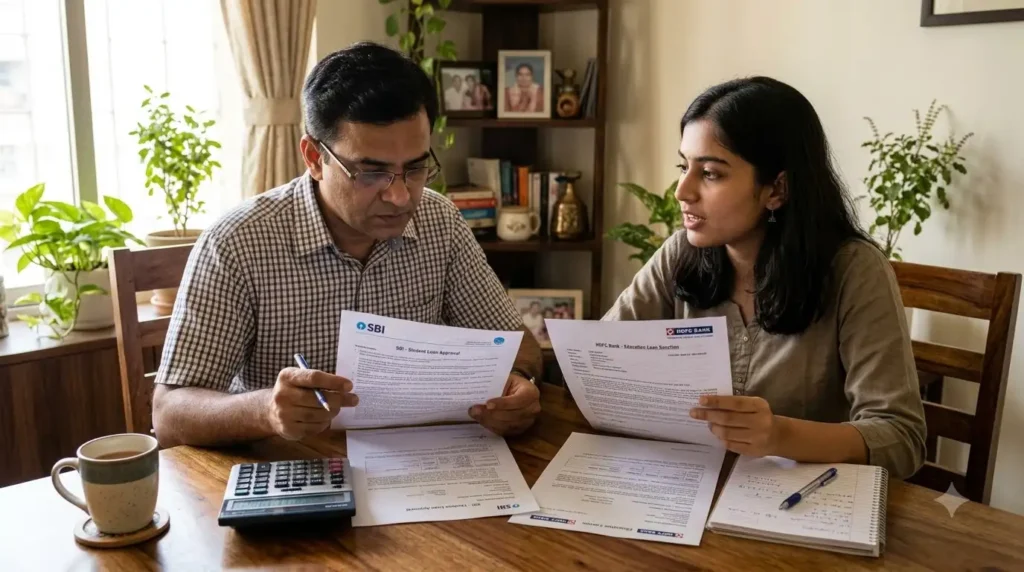
A personal loan in India is often the first option that comes to mind when a family needs money quickly, and studying abroad is no exception. It’s fast, doesn’t always require collateral, and banks approve it without asking what the money is for. That flexibility is exactly why so many parents in Hyderabad and across India default to a personal loan when university fee deadlines are close and an education loan feels like it’s taking too long.
But speed isn’t the only thing that matters when the amount involved is several lakh rupees and the repayment stretches over years. This guide compares a personal loan in India against an education loan on the factors that actually decide your total cost: interest rate, tax treatment, loan amount, and repayment structure, so you can make the right call before signing anything.
A personal loan in India is an unsecured loan, meaning no collateral is required, sanctioned based primarily on your income, credit score, and existing repayment obligations. Banks and NBFCs typically disburse the amount within a few days once documentation is verified, which makes it attractive for anyone facing an urgent expense.
The lender doesn’t ask what the personal loan will be used for, whether it’s a medical emergency, a wedding, or a semester’s tuition fee. That flexibility is a genuine advantage in a pinch, but it comes at a cost that becomes clearer once you compare it directly against a loan built specifically for education.
This is usually the single biggest difference borrowers underestimate. A personal loan interest rate in India typically runs several percentage points higher than an education loan interest rate, since the lender is taking on more risk without any collateral or purpose-specific safeguards.
A secured education loan backed by property or fixed deposits usually offers a meaningfully lower rate than any personal loan in India, precisely because the bank has an asset to fall back on. Even an unsecured education loan, without any collateral, is often priced more favorably than a general-purpose personal loan, because lenders treat education financing as a distinct, lower-risk category with better long-term repayment behavior.
Over a loan tenure of five to ten years, this rate difference compounds into a substantial gap in total repayment, often running into several lakh rupees on a large loan amount.
Interest paid on a personal loan in India offers no tax deduction, regardless of what the money was actually used for. An education loan, on the other hand, qualifies for interest deduction under Section 80E of the Income Tax Act, with no upper limit on the deductible amount, available for up to eight years or until the interest is fully repaid, whichever comes first.
For a family funding an expensive course abroad, this tax benefit alone can offset a meaningful portion of the total interest cost over the loan tenure, something a personal loan simply cannot offer no matter how competitive its rate looks on paper.
Personal loan eligibility is generally capped based on a multiple of your monthly income, and most lenders limit unsecured personal loans to a fraction of what a full overseas course actually costs. This means a personal loan in India often covers only part of the total expense, including tuition, living costs, travel, and insurance, leaving families to arrange the remaining funds separately.
Education loans, particularly secured options, are structured specifically to cover the full cost of attendance, including tuition and living expenses. This is especially important when studying in the USA, UK, or Canada, where the total annual cost of education often exceeds ₹30 to ₹50 lakh.
A personal loan in India requires EMI payments to start almost immediately after disbursement, regardless of whether the borrower has any income yet. This creates real pressure for a student who hasn’t graduated or started earning.
Education loans build in a moratorium period, typically covering the full course duration plus a grace period of six months to a year after graduation, before EMIs begin. This structural difference matters enormously for a student whose degree is the very thing expected to generate future income; repaying a personal loan during the study period, without any income source, can strain the entire family’s finances unnecessarily.
There are situations where a personal loan genuinely fits better than an education loan. If you need a relatively small amount urgently for a visa fee, an admission deposit, or to bridge the gap before your education loan disbursement comes through, a personal loan’s faster processing can be an effective short-term solution.
It’s also a reasonable option if your education loan application is still under review and a hard deadline is approaching. However, before choosing a personal loan, check whether your lender offers a pre-visa disbursement loan. It’s specifically designed to cover this timing gap and typically comes with education loan pricing rather than the higher interest rates associated with personal loans.
Personal loan eligibility in India depends heavily on your CIBIL score, existing monthly obligations, and income stability, with most lenders expecting a score above 700 for favorable terms. Documentation is comparatively light: income proof, bank statements, and identity verification are usually sufficient.
Education loan eligibility instead centers on the admission offer, the course’s cost and duration, and a co-applicant’s income and credit profile, alongside collateral documentation if opting for a secured structure. It generally takes a little longer to process than a personal loan but is built around the specific financial shape of funding a multi-year course rather than a lump-sum personal expense.
Many families choose a personal loan in India simply because it feels faster, without calculating the actual interest cost difference over the full repayment period. Others take a personal loan to cover a shortfall while their education loan is being processed, without checking whether a pre-visa disbursement option was available through the same lender at a much lower rate.
Some borrowers also assume a personal loan is easier to get approved, when in reality a well-documented education loan application, especially with collateral, often has an equally smooth approval path with far better long-term terms. A few families take a personal loan without accounting for the fact that its EMI starts immediately, creating repayment pressure during a period when the student has no income at all.
Before applying for a personal loan in India to cover any part of your education costs, get a clear cost comparison from an education loan consultant first, since the rate difference alone often justifies the extra week or two of processing time. If your only concern is a timing gap before visa appointment or admission deposit, ask specifically about pre-visa disbursement rather than defaulting to a personal loan.
Check your eligibility for both loan types using an eligibility checker before deciding, so you’re comparing actual sanctioned amounts and rates rather than assumptions. If you do need a personal loan for a small, genuinely urgent gap, keep the amount as low as possible and plan to close it quickly once your education loan disburses, rather than letting both loans run in parallel for the full tenure.
A personal loan in India has a real place in short-term, urgent financial gaps, but it’s rarely the most cost-effective way to fund a multi-year course, whether in India or abroad. Between the higher interest rate, the absence of any tax benefit, and the immediate EMI pressure, a personal loan typically costs meaningfully more than a properly structured education loan over the full repayment period.
Before defaulting to a personal loan because it feels quicker, it’s worth spending a few extra days comparing it against a secured or unsecured education loan built specifically for your situation.
Weighing a personal loan against an education loan for your studies? Book a free consultation with Loan Scholar and get a clear cost comparison before you commit to either option.

Book a free consultation and get clarity on your loan journey today.
© 2026 Loan Scholar . All Rights Reserved.Designed, Developed & Marketed by
SDS
Book a free consultation and get clarity on your loan journey today.
© 2026 Loan Scholar . All Rights Reserved.Designed, Developed & Marketed by
SDS