
🎓 Trusted by 10,000+ Students Across India
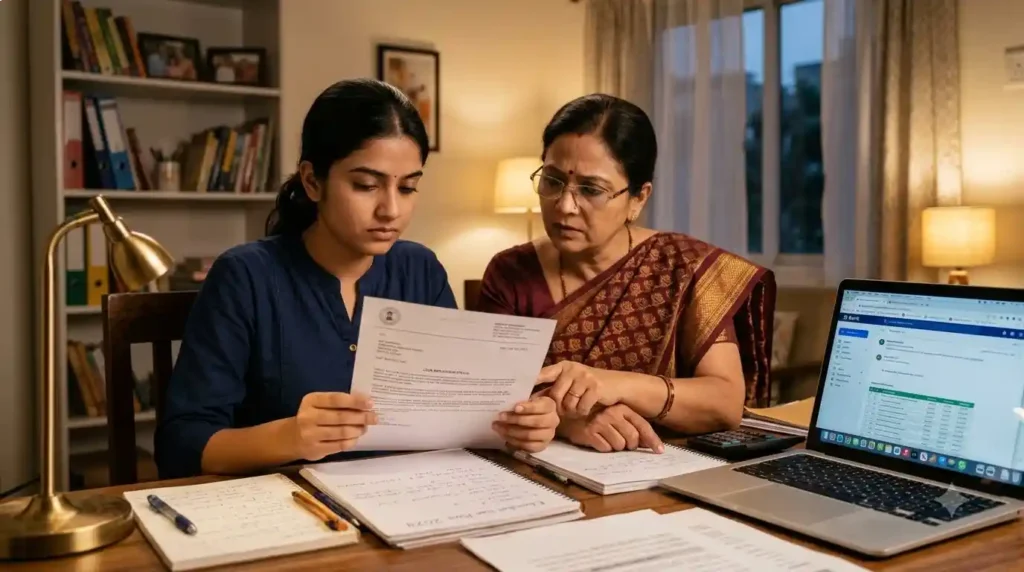
Getting an education loan rejected feels like the process has hit a wall, especially when a visa appointment or fee deadline is already approaching. It isn’t the end of the road. Most rejections stem from a specific, identifiable reason, a documentation gap, a co-applicant issue, or a collateral mismatch, and once you know the actual reason, correcting it and reapplying is usually far more straightforward than students expect.
This guide breaks down the process by rejection reason, so instead of reapplying blindly and risking a second rejection, you know exactly what to check and fix first.
Banks aren’t always explicit about why an education loan application was declined, and many students respond by applying to another bank with the exact same documentation, hoping for a different outcome. This often leads to a second rejection, since the underlying issue, whatever it was, hasn’t actually been addressed.
Before reapplying anywhere, request a clear reason from the lender, even if it takes a follow-up call or a written request. Most banks will indicate at least a general category, income insufficiency, credit score, collateral valuation, or documentation gaps, which tells you exactly where to focus your correction.
It helps to place these three side by side, because students often use the terms interchangeably when they shouldn’t.
A scholarship is typically a one-time or renewable grant awarded for merit, talent, or need, and it does not need to be repaid. An education loan is borrowed money that must be repaid with interest, regardless of the outcome of your studies. An educational assistance scheme sits between the two; it often works alongside a loan or scholarship, subsidizing part of the cost rather than covering it entirely.
In practice, a Hyderabad student might combine all three: a partial scholarship from the university, an assistance scheme that reduces the loan’s interest burden, and an education loan that covers the remaining cost. Approaching the process this way, rather than hunting for a single funding source, is usually what makes overseas or professional education affordable.
Many students reapply to a second bank with identical documentation, without adjusting for the actual reason behind the first rejection, leading to a repeat outcome. Others assume a rejection means they’re entirely ineligible for an education loan, when in most cases it reflects a specific, correctable issue rather than a fundamental disqualification.
Some families panic and turn to a high-interest personal loan as a workaround instead of addressing the education loan rejection directly, ending up with meaningfully worse long-term terms than a corrected education loan application would have offered. Others don’t request a clear rejection reason from the bank at all, guessing at the cause and correcting the wrong thing before reapplying.
Always request the specific rejection reason in writing or through a direct conversation with the loan officer, rather than assuming based on general expectations. Before reapplying, get a second, independent opinion on your corrected application, whether from a different bank’s pre-application assessment or an experienced loan consultant, to confirm the fix actually addresses the issue.
If your rejection involved collateral, get an independent valuation done before approaching another lender, so you’re not surprised by a second, similarly low valuation. Keep a clear record of what was submitted and what was flagged in the first application, so your second attempt is genuinely different rather than a repeat with minor tweaks.
An education loan rejected on the first attempt is rarely a dead end; it’s usually a signal pointing to one specific, fixable issue. Understanding exactly why the rejection happened, whether it’s co-applicant income, credit score, collateral valuation, or documentation, and correcting that specific problem before reapplying consistently leads to a successful second application.
Rushing into a second application without this diagnosis is what turns a single, correctable setback into a repeated, more stressful cycle of rejections.

Book a free consultation and get clarity on your loan journey today.
© 2026 Loan Scholar . All Rights Reserved.Designed, Developed & Marketed by
SDS
Book a free consultation and get clarity on your loan journey today.
© 2026 Loan Scholar . All Rights Reserved.Designed, Developed & Marketed by
SDS