
🎓 Trusted by 10,000+ Students Across India
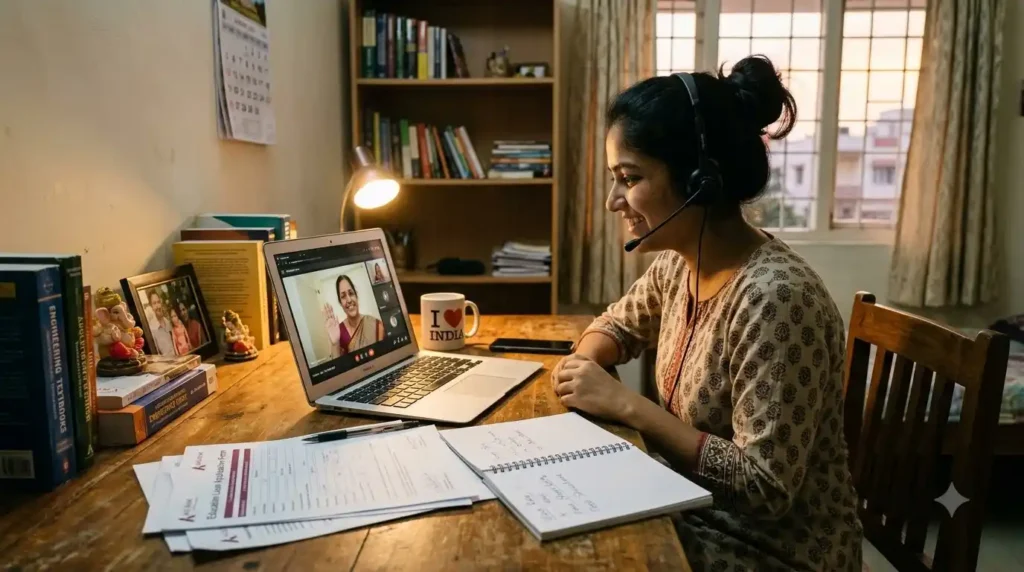
A growing number of Hyderabad students applying for an education loan have one parent working abroad rather than in India, which changes the application in ways that aren’t obvious until you’re deep into the paperwork. Standard income verification, physical signature requirements, and even basic KYC steps assume both applicant and co-applicant are available locally, an assumption that simply doesn’t hold when the co-applicant is in Dubai, the US, or Singapore.
This is a genuinely different process from a standard domestic application, and it’s exactly the kind of situation where education loan consultants who’ve handled NRI cases before save families weeks of avoidable back-and-forth. This guide walks through where the process gets complicated and how it’s typically resolved.
Most lenders require the co-applicant to physically sign loan documents, submit notarized KYC, and sometimes appear in person at a branch. When the co-applicant lives abroad, none of this can happen in the standard way, and each lender has slightly different accommodations for handling it, some more flexible than others.
Income verification also becomes more complex. A salary slip from an Indian employer is a familiar document for any loan officer, but foreign payslips, overseas tax returns, and different currency denominations require additional scrutiny and sometimes translation or attestation, which not every bank branch is equally equipped to process quickly.
This is usually the first major hurdle. Since the NRI co-applicant can’t be physically present to sign documents at each stage of the loan process, most lenders require a registered power of attorney, authorizing someone in India, often the student or another family member, to sign on the co-applicant’s behalf.
Getting this power of attorney correctly executed involves specific legal steps depending on the co-applicant’s country of residence, sometimes requiring attestation at an Indian embassy or consulate abroad before it’s valid for use in India. This step alone can take several weeks if not started early, which is precisely why education loan consultants familiar with NRI cases push families to begin this process the moment they know a foreign co-applicant will be involved.
Foreign income verification typically requires overseas salary slips or employment contracts, sometimes accompanied by a formal translation if the original documents aren’t in English. Banks also often ask for the NRI co-applicant’s foreign bank statements alongside any Indian bank account they maintain, to build a complete picture of income and repayment capacity.
Some lenders are more experienced and comfortable evaluating foreign income than others, which is where lender selection becomes particularly important. Education loan consultants who regularly handle NRI cases usually know which banks process this type of documentation smoothly and which tend to raise repeated queries that slow the process down.
When the co-applicant’s income is in a foreign currency, lenders assess repayment capacity slightly differently, sometimes applying a conversion buffer to account for currency fluctuation risk. This can affect the loan amount a lender is comfortable approving, even when the co-applicant’s actual income, converted to rupees, appears more than sufficient.
Some families also explore whether EMI payments can be made from the NRI co-applicant’s Indian NRE or NRO account, which needs to be confirmed with the specific lender, since not all banks handle this the same way.
NRI co-applicant cases sometimes lean more naturally toward a secured education loan, since collateral can offset some of the additional scrutiny lenders apply to foreign income verification. That said, some lenders do approve unsecured education loans for NRI co-applicant cases with strong, well-documented foreign income, so it’s worth exploring both routes rather than assuming collateral is mandatory.
NRI co-applicant cases generally take longer to process than standard domestic applications, primarily due to the power of attorney execution and additional document verification. This makes early planning particularly important, ideally starting the power of attorney process as soon as you know a foreign-based parent will be the co-applicant, well before you’d normally begin a standard loan application.
If your visa appointment is approaching while this documentation is still being finalized, discussing a pre-visa disbursement loan option with your lender early can help you meet financial proof requirements without waiting for every final document to be in place.
Experienced education loan consultants handling NRI co-applicant cases typically start by clarifying the exact power of attorney format required for the co-applicant’s specific country of residence, since requirements do vary. They coordinate the notarization or embassy attestation process, often working directly with the family to make sure documents are executed correctly the first time, rather than discovering an error after submission.
They also usually know which lenders process foreign income documentation most smoothly, saving families from submitting to a bank that’s likely to raise repeated, time-consuming queries. Because this is a genuinely specialized situation, working with someone who’s handled it before, rather than a general loan applicant with no NRI-specific experience, tends to make a meaningful difference in how smoothly the process moves.
Many families don’t realize a power of attorney is required until well into the application process, losing valuable time that could have been used productively if started earlier. Others submit foreign income documents without proper translation or attestation, leading to repeated requests from the lender that stretch the timeline considerably.
Some families approach a bank with no specific experience handling NRI co-applicant cases, resulting in slower processing simply because the loan officer isn’t familiar with how to evaluate foreign income or coordinate power of attorney documentation. A frequent mistake is not confirming EMI payment logistics from an NRE or NRO account in advance, discovering complications only once repayment is supposed to begin.
Start the power of attorney process the moment you know your co-applicant will be based abroad, since embassy attestation and registration steps often take longer than expected. Ask your chosen lender directly about their specific experience with foreign income verification, and request examples of similar cases they’ve processed recently.
Confirm early which currency and account your EMI payments will be made from, and check whether the co-applicant’s foreign income needs any additional conversion buffer applied to your approved loan amount. If your visa timeline is tight, flag this to your lender as early as possible so power of attorney execution, documentation, and disbursement can be planned around it rather than causing a last-minute scramble.
An NRI co-applicant genuinely changes how an education loan application moves through the system, from power of attorney execution to foreign income verification to currency-related repayment considerations. Families navigating this for the first time benefit significantly from education loan consultants who’ve handled similar cases before, since the specific documentation and timeline pitfalls in this situation are easy to miss until they’ve already caused a delay.
Starting the power of attorney process early and choosing a lender genuinely comfortable with foreign income documentation are the two decisions that most consistently determine how smoothly this specific type of application goes.
Have an NRI parent as your co-applicant and not sure where to start? Book a free consultation with Loan Scholar and get guidance built specifically around cross-border co-applicant cases.

Book a free consultation and get clarity on your loan journey today.
© 2026 Loan Scholar . All Rights Reserved.Designed, Developed & Marketed by
SDS
Book a free consultation and get clarity on your loan journey today.
© 2026 Loan Scholar . All Rights Reserved.Designed, Developed & Marketed by
SDS