
🎓 Trusted by 10,000+ Students Across India
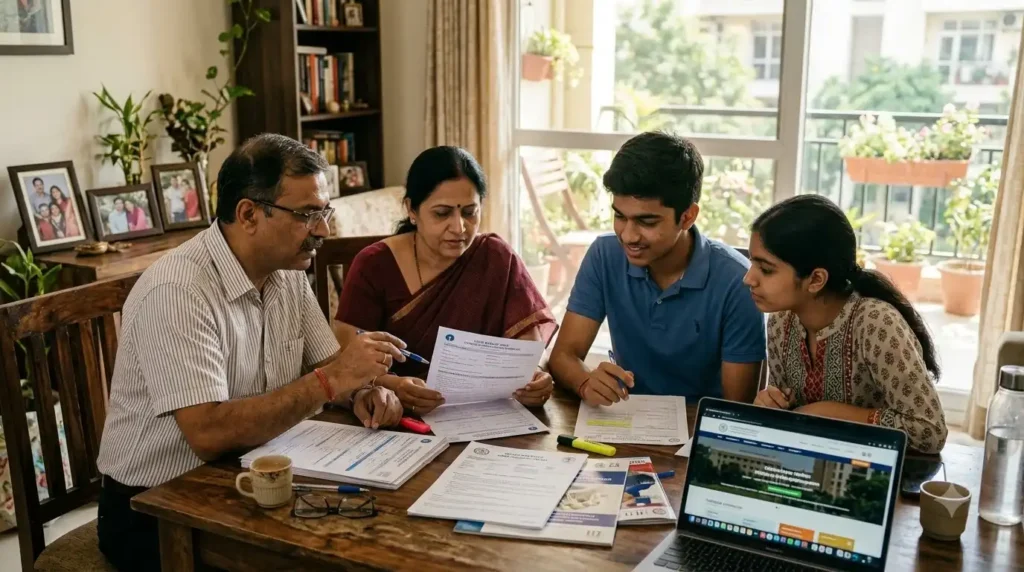
Most conversations around education loans jump straight to studying abroad, but a large share of Indian students, in Hyderabad and across the country, need financing for professional courses within India: engineering, medicine, an MBA, or a specialized diploma. The loan structure, interest rates, and government support available for these domestic courses differ from what applies to overseas education, and treating them the same way often leads families to miss better options.
This guide focuses specifically on how an education loan for Indian students pursuing courses within the country works, from eligibility to interest rates to repayment, so you can make an informed decision without assuming the overseas process applies here too.
An education loan for Indian students studying domestically typically involves a lower loan amount, shorter processing time, and often lower interest rates than loans for overseas courses, since living costs and currency risk aren’t part of the equation. Government-backed interest subsidy schemes are also more commonly available for domestic professional courses, particularly for students from economically weaker backgrounds.
The eligibility criteria still hinge on a strong co-applicant, usually a parent, but the collateral expectations are often more flexible for moderate loan amounts, since domestic course costs are generally lower than international ones.
Lenders generally look at the student’s academic record in the qualifying examination, the reputation and placement record of the institution, and the co-applicant’s income and credit profile. For professional courses like medicine or engineering, some lenders also factor in the college’s accreditation and historical loan repayment behavior from previous students, since this affects their risk assessment for the specific institution.
Unlike overseas loans, where collateral often becomes necessary once the amount crosses a certain threshold, many domestic education loans for moderate amounts remain accessible through an unsecured education loan structure, particularly for well-regarded institutions with strong placement outcomes.
Interest rates on domestic education loans are generally lower than personal loans and often lower than loans for overseas study, particularly under government-backed interest subsidy schemes targeted at students from economically weaker sections pursuing professional courses. Telangana’s state government, alongside central schemes, runs specific support programs for domestic higher education that Hyderabad students should check before finalizing their loan structure.
For larger amounts, particularly for premier medical or MBA programs, a secured education loan against property or fixed deposits can bring the interest rate down further, similar to how it works for overseas courses, just typically requiring a smaller loan amount overall.
Most domestic education loans include a moratorium period covering the course duration, with EMI payments typically beginning six months to a year after course completion, similar to overseas loan structures. Interest paid during this period may still accrue, so understanding whether your lender offers a simple interest or partial interest payment option during the study period can meaningfully affect your total repayment amount.
Interest paid on a domestic education loan also qualifies for deduction under Section 80E of the Income Tax Act, with no upper limit on the deductible interest amount, available for up to eight years from the start of repayment.
Many students assume a domestic education loan will automatically be easier to get than an overseas one, and apply without checking the specific lender’s list of recognized institutions, which can still lead to rejection for lesser-known colleges. Others underestimate the total cost of a professional course, focusing only on tuition and missing hostel fees, mess charges, and equipment or book costs specific to engineering or medical programs.
Some families don’t explore available interest subsidy schemes at all, assuming these only apply to overseas education, and end up paying a higher effective rate than necessary. A frequent mistake is not comparing lenders for domestic loans with the same rigor applied to overseas ones, settling for whichever bank branch is most convenient rather than the one offering the best terms.
Check your target institution’s placement record and accreditation status before applying, since this genuinely affects how favorably lenders view the loan, particularly for engineering and MBA programs. Ask specifically about interest subsidy eligibility under both central and Telangana state schemes before finalizing your loan structure, since many families miss this simply by not asking.
Compare at least two or three lenders for domestic loans just as you would for an overseas one, since interest rates and processing fees do vary meaningfully even for similar course types. If your course spans multiple years, like MBBS or a four-year engineering program, clarify with your lender whether disbursement happens annually or as a lump sum, since this affects how you plan your family’s cash flow alongside the loan.
An education loan for Indian students isn’t only relevant to those heading overseas. Domestic professional courses, engineering, medicine, MBA programs, and specialized diplomas, often carry substantial costs that genuinely benefit from proper loan planning, interest subsidy research, and lender comparison, just as overseas education does.
Families who treat domestic education financing with the same seriousness as overseas planning, checking subsidy eligibility, comparing lenders, and understanding the full cost of the course, generally end up with better terms and far less financial strain during the study period.

Book a free consultation and get clarity on your loan journey today.
© 2026 Loan Scholar . All Rights Reserved.Designed, Developed & Marketed by
SDS
Book a free consultation and get clarity on your loan journey today.
© 2026 Loan Scholar . All Rights Reserved.Designed, Developed & Marketed by
SDS